
Signs Your Child Is Ready to Start Preschool

September 29, 2026

There's no single age that makes a child "ready" for preschool — we've had three-year-olds settle in within a week and others who needed an extra month at home first, and both are perfectly normal. Instead of watching the calendar, here's what we actually watch for when a new family visits us in Elkhorn, Millard, or Valley.


Curiosity about the world beyond home

Children who point at things and ask what they are, who want to help with tasks around the house, or who show interest in other children at the park are often signaling that they're ready for a bigger environment to explore.


Some basic self-care skills

Your child doesn't need to be fully independent, but skills like drinking from an open cup, attempting to pull on their own shoes, or communicating a basic need make the daily transition smoother for everyone.


Comfort with brief separation

Some tears at drop-off are completely normal, even expected, and they usually fade within the first couple of weeks. What we look for is whether a child can be soothed by a trusted adult other than a parent — a sign they're ready to build that trust with a teacher.


Interest in other children

Watching, imitating, or even quietly observing other children play is often the first stage of social readiness, well before a child is playing cooperatively. If your child lights up around other kids — even just watching from a distance — that's a good sign.


A flexible daily rhythm

Children who can adapt to a shift in routine, like a slightly later nap or a new caregiver, tend to adjust to a classroom schedule more easily than children on a very rigid routine at home.


If you're still not sure

Readiness isn't all-or-nothing, and a good program should meet your child partway. A short visit to observe a classroom in session, without any pressure to enroll that day, usually tells parents more than any checklist can. We're currently enrolling for families across Elkhorn, Millard, and Valley, and we're always happy to have you come see a classroom in session before deciding on anything.

See a classroom in session before you decide on anything.
Schedule a Visit
September 29, 2026
If you've toured a Montessori classroom for the first time, you've probably noticed what's missing: no rows of desks facing a whiteboard, no single teacher lecturing to twenty children at once. Instead, you'll find children of different ages moving purposefully around the room, choosing their own work from low shelves, and returning materials carefully when they're finished. It can look like organized chaos to an outside eye. In practice, it's one of the most carefully designed learning environments in early childhood education. The prepared environment Dr. Maria Montessori believed that children learn best when the environment itself does the teaching. Every shelf, material, and piece of furniture in our classrooms is scaled to a child's size and placed with intention, so that children can select work independently and complete it without waiting on an adult. This isn't about giving children free rein to do whatever they want — it's about giving them the freedom to choose meaningful work within clear, consistent boundaries. Mixed-age classrooms Montessori classrooms typically group children across a three-year age span, such as our Toddler Program for children 18 months to 3 years, and our Primary Program for children 3 to 6 years. Younger children watch older children work and are quietly motivated to grow into that role. Older children reinforce their own understanding by helping a younger classmate, which builds patience, leadership, and confidence long before those words mean anything to a five-year-old. Hands-on, self-correcting materials Montessori materials are designed so a child can see their own mistake and correct it, without a teacher stepping in to say "no, try again." A cylinder that doesn't fit its socket, a tower that topples because it was stacked out of order — the material itself gives the feedback. This builds concentration and problem-solving skills that carry well beyond the classroom, and it removes a lot of the fear of "getting it wrong" that can follow children into later schooling.
September 29, 2026
One of the most common questions we hear from families is a simple one: which classroom does my child belong in? The answer usually has less to do with your child's exact age and more to do with what stage of development they're in. Here's how the two programs differ, and how we help you decide. Toddler Program: 18 months to 3 years This stage is about movement, language explosion, and independence in the most basic sense — feeding themselves, washing their hands, putting on their own shoes. Our Toddler Program is built around short, repeatable activities that build coordination and a sense of order. Toddlers thrive on predictable routines, so the classroom day follows a steady rhythm they can count on: work time, snack, outdoor time, rest. You'll notice fewer abstract materials in this room and more real, functional objects: child-sized pitchers, brooms, and washing basins. At this age, children aren't ready to pretend to pour water — they want to actually pour it, and get to practice until they're good at it. Primary Program: 3 to 6 years By age three, most children have the fine motor control and attention span to work with more complex materials — the ones people usually picture when they think of Montessori: the pink tower, sandpaper letters, bead chains for early math. This is also the age where the mixed three-year age span really shows its value, since a six-year-old and a three-year-old in the same room are working at very different levels, side by side. The Primary classroom is where children move from concrete, hands-on exploration toward early reading, writing, and mathematical reasoning — but always at their own pace, and always by choice rather than assignment. What if my child is right on the line? Age is a starting point, not the deciding factor. We look at a child's language, coordination, ability to follow a short routine, and comfort separating from a parent. Some children move from Toddler to Primary a little before their third birthday; others benefit from a few extra months. We talk through this with every family individually, since no two three-year-olds arrive at the same place. Choose Toddler if: your child is still building basic self-care skills and thrives on short, repeated routines. Choose Primary if: your child has longer attention spans, is curious about letters and numbers, and works well alongside other children. Not sure? A short observation visit tells us more than a birth date ever could. Both programs share the same underlying philosophy — respect for the child's pace, hands-on materials, and a prepared environment — they just meet your child where they are right now.
September 29, 2026
Parents often ask us how to keep the momentum going once their child leaves for the day. The good news: you don't need a room full of specialty materials to bring Montessori thinking home. Most of it comes down to a shift in how you set up the space and how you respond in the small moments. Here are five places to start. 1. Lower the shelf, not the expectation Keep a few toys, books, and everyday items — cups, a small pitcher, art supplies — on shelves your child can reach without help. When children can get their own things and put them back, they stop needing you to manage every transition of the day, and you'll notice fewer meltdowns over "I wanted to do it myself." 2. Let real chores be real Toddlers are drawn to the same tasks adults do: wiping a table, sweeping, folding a washcloth. A children's version of these tools — a small broom, a low step stool at the sink — turns a chore into an activity they'll ask to repeat, sometimes to your mild frustration when it takes three times as long. 3. Offer two good choices, not twenty "What do you want for breakfast?" is overwhelming. "Would you like oatmeal or eggs?" gives a real sense of control within a boundary you're comfortable with. This small habit builds decision-making skills and cuts down on the power struggles that come from either too much choice or none at all. 4. Protect uninterrupted work time When your child is deeply focused on something — stacking blocks, drawing, sorting buttons — resist the urge to jump in and help or narrate. Interrupting concentration, even with praise, breaks it. Let them finish, make mistakes, and try again on their own terms. 5. Follow the child, not the trend You don't need every wooden toy on a curated Instagram shelf. Watch what your child is actually drawn to right now — sorting, pouring, climbing, naming things — and offer more of that. Interest is the best guide you have. None of this requires a full classroom setup. It requires a bit of patience and a willingness to let your child do things more slowly than you would. For more ideas tailored to your child's age, our Montessori at Home page has additional room-by-room suggestions.
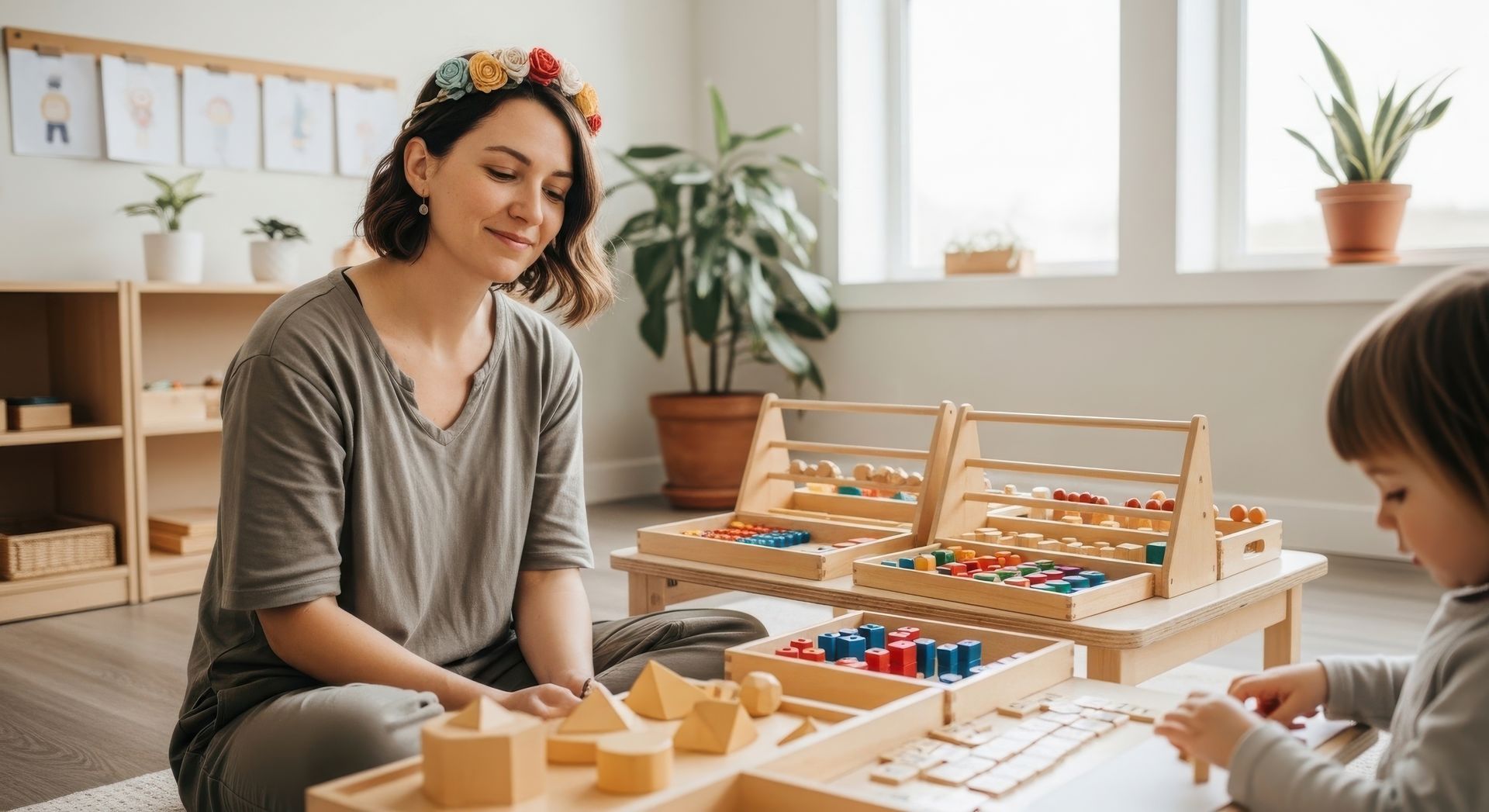
A teacher and child use colorful wooden counting materials on a low table for Montessori education.
By Christine Grothe • August 14, 2026
Compare Montessori vs. traditional preschool in Elkhorn, NE. Montessori Academy of West Omaha offers child-led learning for ages 18 months to 6. Enroll today.
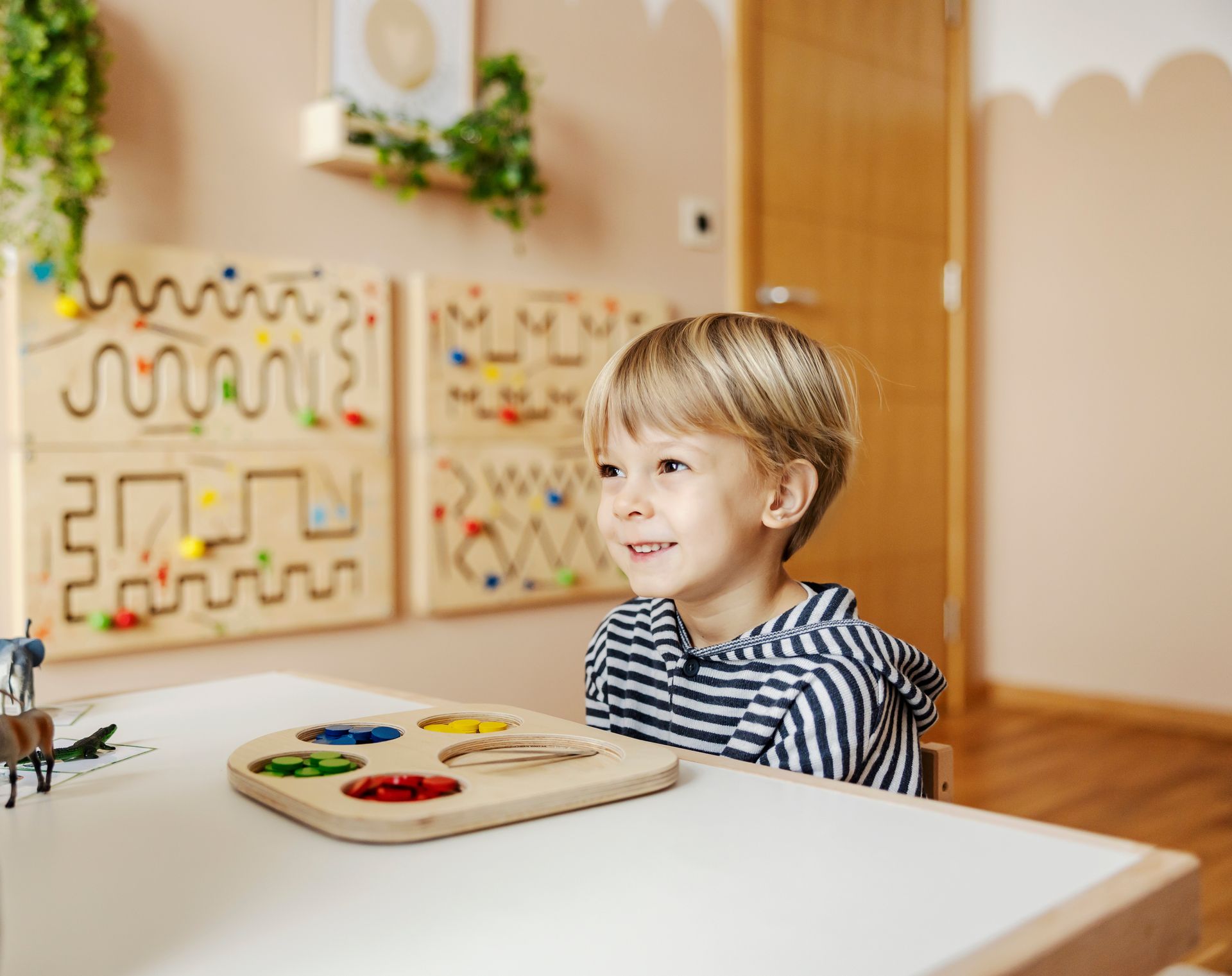
Young boy smiling at a table with a wooden Montessori color-sorting tray.
August 6, 2026
Discover the Montessori toddler program in Elkhorn, NE. Build independence & lifelong learning. Enroll today! Call 402-884-2424.